Boston Fern
Nephrolepis exaltata
Más nevek: Sword Fern, Nephrolepis exaltata
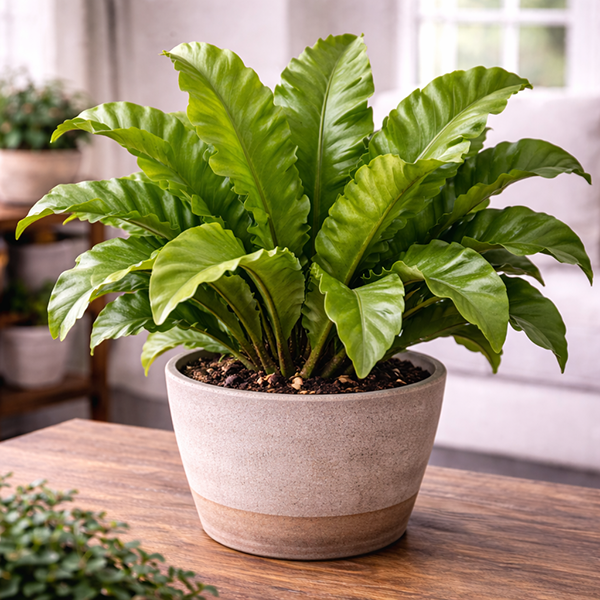
The Boston fern (Nephrolepis exaltata) is a popular evergreen fern commonly used as a houseplant. It prefers medium growth rate, partial shade, and requires high humidity and regular watering.
Basic info
The Boston fern (Nephrolepis exaltata) belongs to the Nephrolepidaceae family and is native to tropical America. It is widely appreciated as an indoor ornamental plant due to its lush, arching green fronds that create a natural and soothing atmosphere. The plant features long, slender leaves that often cascade from hanging baskets.
It does not produce significant flowers, and its ornamental value lies in its foliage. The Boston fern requires high humidity and consistent moisture but is sensitive to waterlogging. It thrives in loose, nutrient-rich, slightly acidic to neutral soil. During winter, watering should be reduced, and temperatures below 15 °C should be avoided.
Propagation is typically done by dividing rhizomes or runners in spring. Care level is moderate, involving regular fertilization and removal of dead fronds. The plant is non-toxic to humans and pets and does not cause allergies.
Size & appearance
Environment needs
Care
For optimal care, place the Boston fern in a bright location with indirect sunlight. Keep the soil consistently moist but avoid water stagnation. Regular misting helps maintain humidity, especially during heating seasons. Fertilize every two weeks from spring to autumn, and reduce watering in winter.
Propagation
Propagation is best done in spring by dividing healthy rhizomes or runners. Use a clean, sharp knife to separate sections and plant them in loose, nutrient-rich soil, keeping the substrate moist.
Diseases & pests
Common issues include root rot caused by overwatering and infestations of spider mites or aphids on the leaves. Proper watering and regular misting help prevent pests. In severe cases, insecticides may be necessary.
Ehhez a növényhez még nincs betegség/kártevő információ rögzítve.
Safety
The Boston fern is non-toxic to humans, dogs, and cats, making it a safe choice for households with children and pets. It does not trigger allergic reactions.
Ecology
Primarily an indoor plant, the Boston fern contributes to indoor air purification and humidity regulation, enhancing the microclimate of living spaces.
Usage
Used mainly for decorative purposes, the Boston fern is ideal for hanging baskets or as a tabletop plant in shaded or partially shaded areas. It is not edible and has no medicinal uses.